Sentinelle Auto · United States
EV charging stations near me: what to check before setting off
When you search for EV charging stations near me, start with compatibility, road access and a usable payment method. Then compare the full session cost and the time that fits your stop. The closest map marker is only a candidate: it does not reserve a connector, confirm that your vehicle can use it or guarantee the price when you arrive.
This guide is for public charging in the United States. Examples use US dollars and miles, with energy measured in kilowatt-hours. All numerical tariffs are fictional teaching examples, not live prices or nationwide averages. Check your vehicle manual, the charging operator and the conditions at the individual location before relying on a stop. Manufacturer instructions take priority over a general guide.
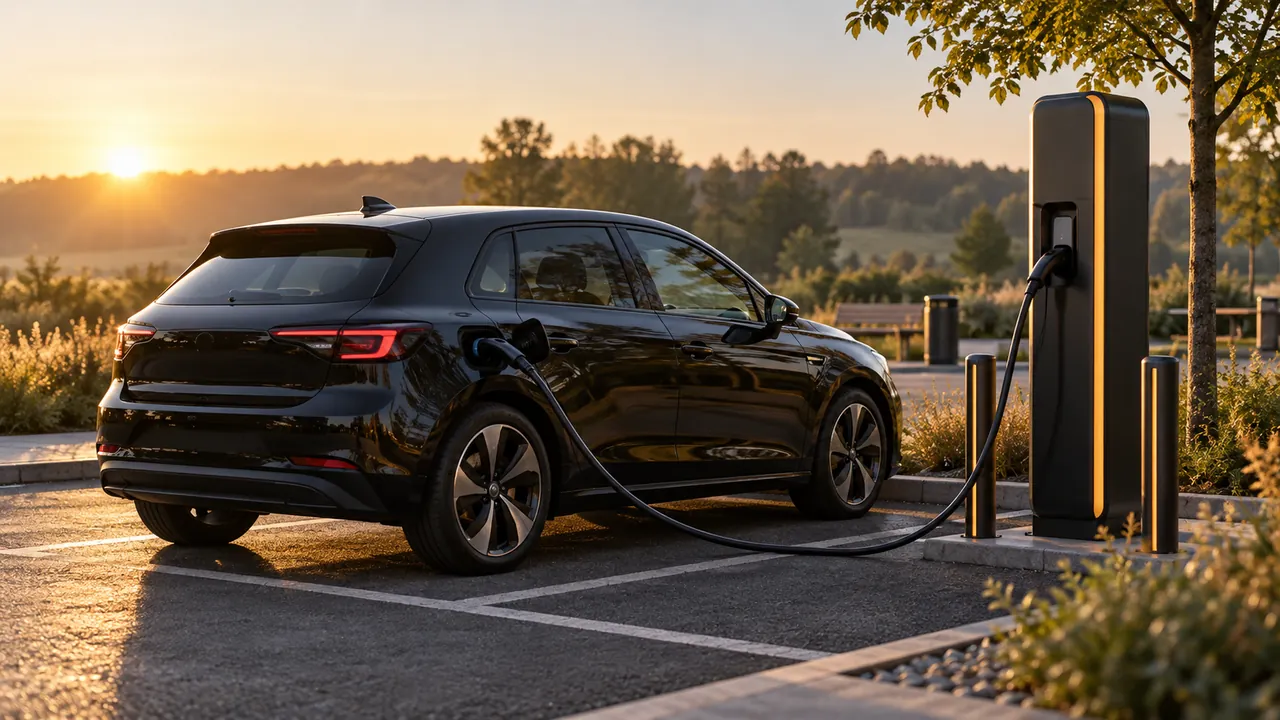
Decide what the stop needs to accomplish
A short highway break and an afternoon at a destination call for different searches. Write down where you need to go next, your available stopping time and the energy you need for the next leg. Looking for the largest power number before defining that need can lead to an inconvenient station or an unnecessary detour.
If you are parking for several hours, compatible Level 2 charging may fit the visit. On a longer journey, compatible DC fast charging may better suit a shorter break. Neither choice is automatically best for every driver. A plug-in hybrid may have different charging capabilities from a battery-electric vehicle, and equipment options can vary between model years.
Choose a main stop and a reachable alternative before you leave. Record the operator and location, rather than relying only on a screenshot of a map pin. Check whether the alternative still works if your first stop fails. Two chargers behind the same locked gate may share the same access problem. Prepare searches while parked, and avoid handling a phone while driving.
Match the connector to the specific car
The US Department of Energy's AFDC consumer guide describes AC and DC charging and the connector families used in the United States, including J1772, CCS, CHAdeMO and NACS. Use that overview to understand the vocabulary, then check the exact charging inlet and capabilities of your own car. Connector appearance alone does not establish permission to use an adapter or a network.
Ask three separate questions: does the connector fit, does the car support that type of charging, and does the network support your particular vehicle and payment arrangement? An approved adapter may be required for some combinations. Follow the vehicle manufacturer's and network's current instructions. Do not assume every vehicle of one brand has identical access simply because a newer model does.
For AC charging, confirm whether a cable is supplied and whether you need any equipment of your own. For DC charging, check the station's connector options and the car's accepted charging rate. A powerful station cannot force a vehicle to accept its advertised maximum. Battery conditions and the stage of the session can also change the rate you receive.
Understand what a station listing actually tells you
The AFDC Station Locator information distinguishes charging stations, ports and connectors and offers location and route searches. A site can have multiple ports, while an individual port can present more than one connector. Read the details instead of treating every connector symbol as a separate vehicle space available to you.
Check whether a listing describes public access, restricted access, a planned installation or a current operating location. If a status is shown, look for its update time and source. A static equipment record is different from live occupancy information. Even a recent available status can change while you are approaching. Missing status information should remain unknown rather than being interpreted as free.
Use the actual entrance when checking directions. A charger across a divided road, inside a garage or beyond a shopping center barrier may require a different approach from the nearest address. Look at operating hours, parking rules and any access restriction relevant to your visit. Being visible on a public map does not mean a location is accessible to every driver at every hour.
Compare the complete bill, not just cents per kWh
List the energy charge, session charge, applicable time or idle fees and any additional parking cost. Compare the offer attached to your own account or direct-payment method. A membership price, a roaming app price and an ad hoc price can differ. Do not use a member-only rate in a calculation unless you qualify and have included any relevant subscription cost.
Here is a fictional comparison. You expect to buy 30 kWh. Option A charges $0.40 per kWh plus a $2 session fee, making $14 before any other charges. Option B charges $0.45 per kWh with no session fee, making $13.50. B has the higher energy rate but the lower total for this purchase. At a different quantity, the result could change.
If taxes or parking charges are additional, include them when the applicable amount is known. If you cannot establish a charge, label the comparison incomplete rather than quietly assuming zero. Save the terms you accepted and the receipt. An exact-looking total from uncertain assumptions is still an estimate, and none of the sample amounts here is a current US charging offer.
Keep power, energy and charging time separate
Kilowatts, abbreviated kW, measure power. Kilowatt-hours, abbreviated kWh, measure energy. A simplified time estimate is energy divided by average power. Delivering 24 kWh at an assumed average 48 kW takes half an hour in that model. It does not establish the duration at a station whose sign displays 48 kW or more.
Maximum power is not average power throughout a session. Use information appropriate to the car and conditions rather than multiplying the largest advertised number by every minute you plan to stop. The vehicle's battery state, temperature and charging capability matter. Connection, payment and waiting time also belong in your travel plan, even though they are not part of the energy-transfer calculation.
Do not equate billed energy automatically with a guaranteed number of miles added. Energy drawn from equipment, energy stored in the battery and energy used for driving are different quantities. For illustration, at an assumed driving consumption of 0.30 kWh per mile, 18 kWh used for travel corresponds to 60 miles. That arithmetic is not a range promise and excludes charging losses and changing road conditions.
Count the miles added by the charging choice
Compare two complete journeys with the same origin and destination. A station three miles from an exit does not necessarily add three miles to the trip. Include the permitted approach, the way back to your route and any road layout that changes the return. Additional time and tolls can matter more than a small difference in the posted energy rate.
Suppose a fictional alternative adds 10 miles. With a chosen driving assumption of 0.30 kWh per mile, that adds an estimated 3 kWh of driving energy. To assign a dollar amount, you still need an explicit energy-cost assumption and an appropriate treatment of charging losses. Do not call a lower charging rate a saving without allowing for the additional journey needed to obtain it.
Our fuel detour guide explains the same trip-comparison principle using Canadian gasoline examples. Its litre and Canadian-dollar calculations are not EV calculations or US prices. For United States fuel context, see the US station comparison page. Keeping units and markets visible prevents an apparently simple comparison from mixing incompatible numbers.
Make a practical backup plan
Plan the alternative while you have choices, rather than waiting until the first stop has failed. Check connector compatibility, access and payment for the backup too. A second map marker is not useful if it requires a cable you do not have, an unavailable account or a parking area that closes before you arrive.
There is no single reserve percentage that fits every car and journey. Use the vehicle's guidance and account for the next reachable option, weather and route conditions. If a plan leaves no margin for a closed site or unexpected consumption, choose an earlier stop. Do not pass every usable location to chase an uncertain small discount with a nearly depleted battery.
For a hotel or destination charger, ask whether charging is restricted to guests, whether a space can be reserved and how it is billed. A hotel amenity listing may describe equipment without guaranteeing an assigned space. If you tow or need additional maneuvering room, check the layout separately. A compatible connector does not prove the parking space suits the vehicle combination.
At the charger, confirm the session has started
Match the selected equipment identifier to the actual unit. Read the price and terms through the operator's official payment process. Follow the instructions on the equipment and in the vehicle manual. If hardware looks damaged or an instruction seems inconsistent, use the published support contact and choose another option when necessary; do not improvise a repair or an unapproved connection.
After authorization, look for confirmation in both the charger interface and the vehicle that charging is occurring. A card authorization or a lit screen alone does not establish energy transfer. If the attempt fails, record the equipment number and error message before contacting support. Repeatedly initiating payments without understanding the error can make it harder to reconcile what happened.
When you finish, stop and disconnect according to the instructions, check that the session is closed and save the receipt. Move the car when the parking conditions require it. Compare the recorded energy, time and total with the accepted terms. Distinguish a temporary payment authorization from a final charge by checking the operator's explanation and your payment records.
Build a charging record that helps the next decision
Record the date, location, billed kWh, total cost and separate fees. Add a short note about access and whether the stop fitted an activity you already planned. Several comparable receipts can tell you more about your own charging pattern than a widely shared claim about the cheapest network. A single promotion or unusual session is not necessarily a normal monthly cost.
Keep home charging, workplace charging and public charging separate when reviewing a budget. A household electricity bill may include many loads unrelated to the car. Likewise, a public charging receipt may include parking or time charges. Label the scope of each figure before comparing it with a gasoline bill, and use cost per distance only with clear vehicle-consumption assumptions.
For a mixed household fleet, do not enter kWh in fields intended for gallons or litres. Our fuel calculator addresses fuel assumptions, not a full EV charging tariff simulation. A guide should make that boundary clear rather than imply a tool covers every charging contract. Use the operator's current offer to work out a particular charging purchase.
Quick answers before your next trip
Does the nearest charger automatically make the best stop?
No. Access, connector compatibility, the full bill and the time available can make another location more suitable. Compare the actual road route instead of straight-line distance. Keep an alternative that the vehicle can still reach if your first choice is unavailable.
Can I rely on a map to guarantee availability?
A map record establishes only what its source and timestamp support. A dynamic status is a snapshot, not a reservation. Check the operator's current information and any separate reservation conditions. A missing occupancy field should not become an assumption that the equipment is free.
What does Sentinelle Auto guarantee about a stop?
Read the Sentinelle Auto product page for described functions and coverage. Information can vary by source and location. Finding a charger does not itself authorize a session, reserve a port or guarantee a tariff. Our sources and method explain the editorial checks and the difference between verified information and an illustration.
What is the simplest preparation routine?
Choose the next leg, verify a compatible main stop and backup, read the payment terms, and confirm real charging on arrival. Review the receipt afterward to improve your next estimate. For the rest of our practical driving guides, visit the Sentinelle Auto blog. The useful result is a manageable trip plan, not the longest list of nearby pins.